India’s economic engine is gaining momentum, with growth projected to accelerate to 6.7% in FY 2025-26, surpassing earlier forecasts. According to a Reuters poll and upward revisions by the IMF, World Bank, and Reserve Bank of India (RBI), the country is set to maintain its status as the world’s fastest-growing major economy. The upbeat outlook follows a robust first quarter showing 7.8% GDP growth, driven by strong domestic consumption, industrial expansion, and an ongoing wave of public and private investment.
Global agencies cite India’s resilient internal demand, policy stability, and digital transformation as the foundation of this outperformance—even as other major economies face stagnation and trade tensions.
Growth Engines: Consumption, Investment, and Policy Momentum
The backbone of India’s growth story continues to be domestic consumption, bolstered by urban spending, expanding digital ecosystems, and a steady rise in employment. Government-led infrastructure projects—ranging from expressways and renewable energy corridors to digital governance platforms—are injecting vitality into both rural and urban economies.
A Favorable monsoon, combined with record foodgrain procurement, has lifted rural purchasing power. Meanwhile, the e-commerce boom, coupled with financial inclusion programs, has sustained urban consumption trends.
On the investment front, both domestic capital formation and foreign direct investment (FDI) remain buoyant. Reforms such as GST 2.0, simplified FDI rules, and the rollout of digital financial infrastructure have boosted investor confidence. The services sector, led by technology, finance, tourism, and logistics, continues to outperform expectations, while manufacturing is reaping benefits from the government’s Production Linked Incentive (PLI) schemes and the China+1 diversification strategy adopted by global supply chains.
MSMEs and Reforms: The Growth Multiplier
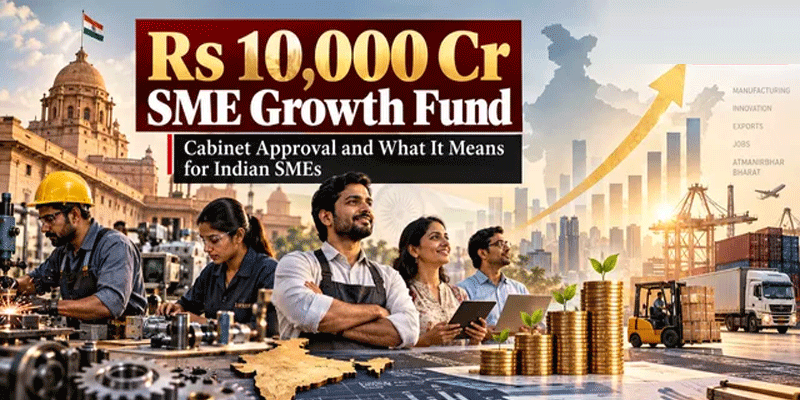
India’s 60 million Micro, Small, and Medium Enterprises (MSMEs) play a central role in sustaining inclusive growth. These businesses, particularly in tier-2 and tier-3 cities, are being strengthened by expanded credit guarantees, digital market platforms, and improved logistics infrastructure.
However, the sector still faces challenges, including rising input costs, compliance burdens, and volatile global supply chains. Continued structural reforms—especially those improving access to finance, technology, and exports—will be vital in ensuring that MSMEs remain competitive contributors to India’s growth trajectory.
External Challenges: Tariffs, Trade, and Energy Volatility
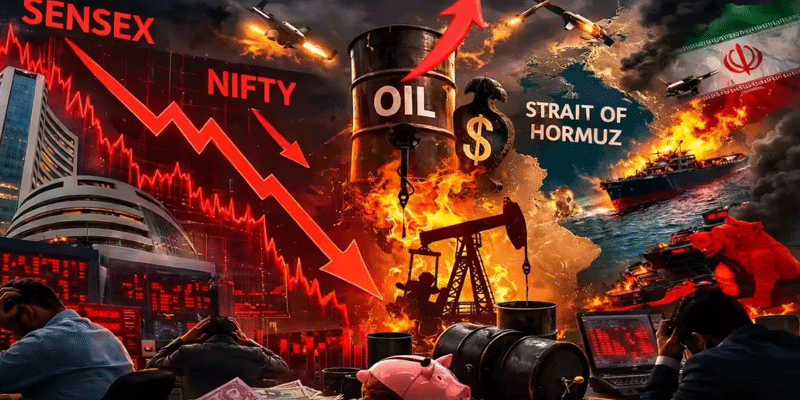
Despite strong fundamentals, India’s outlook isn’t without risks. The recent US tariff hike to 50% on Indian exports has created pressure on sectors like textiles, engineering goods, and chemicals. Additionally, fluctuating crude oil prices pose a potential strain on India’s import bill and inflation outlook.
Nonetheless, the IMF expects India’s domestic demand resilience to cushion these shocks, revising its growth forecast upward by 0.2 percentage points in its latest World Economic Outlook.
Policy Focus: Managing Growth and Inflation
The RBI has opted for a measured monetary stance, maintaining the repo rate at 5.5% to balance growth with inflation control. It anticipates GDP growth at 6.8% for FY 2025-26, emphasizing that private consumption, credit expansion, and public capital expenditure will remain strong. Fiscal policy is gradually consolidating, though spending on infrastructure, green energy, and social programs remains a key priority.
A Confident Path Ahead
India’s expected 6.7% growth for FY2025-26 underscores its resilience amid global uncertainty. Structural reforms, digital innovation, and youthful demographics are creating a foundation for sustained expansion even as trade frictions and energy market shifts test the economy’s adaptability.
The path forward will depend on staying reform-focused, diversifying exports, and strengthening energy security. If managed well, India will not only retain its title as the fastest-growing major economy but also reinforce its position as a pillar of stability and opportunity in the global landscape.
(With agency inputs)